
CAUTION: which SNV is your VKORC1 assay is using?
The recent publication
"Limitations of VKORC1 rs9934438 as a Surrogate Marker for Vitamin K Antagonist Dose Adjustment" Abraham García-López, Andrea Guzmán-de Antonio, Tania S. Rubio-Lepe, Elena Diago-Sempere, Juan Raffo-Nogueira, Pedro Arias, Belén Ferrer-Martínez, Sonia Rodriguez-Novoa, Antonio J. Carcas, Irene García-García, Rocío Rosas-Alonso, Alberto M. Borobia
PMID: 42823629
cautions against the use of VKORC1 SNV rs9934438 as a substitute for rs9923231 in clinical practice. The paper discussed a survey from 2017 that showed although the majority of labs were testing either just the functional rs9923231 or both rs9923231 and rs9934438, a small portion (4%) were only testing rs9934438.
"Although concordance was high overall, rs9934438 misclassified two patients who, according to rs9923231, required a reduced VKA dose, resulting in potential false-negative classifications."
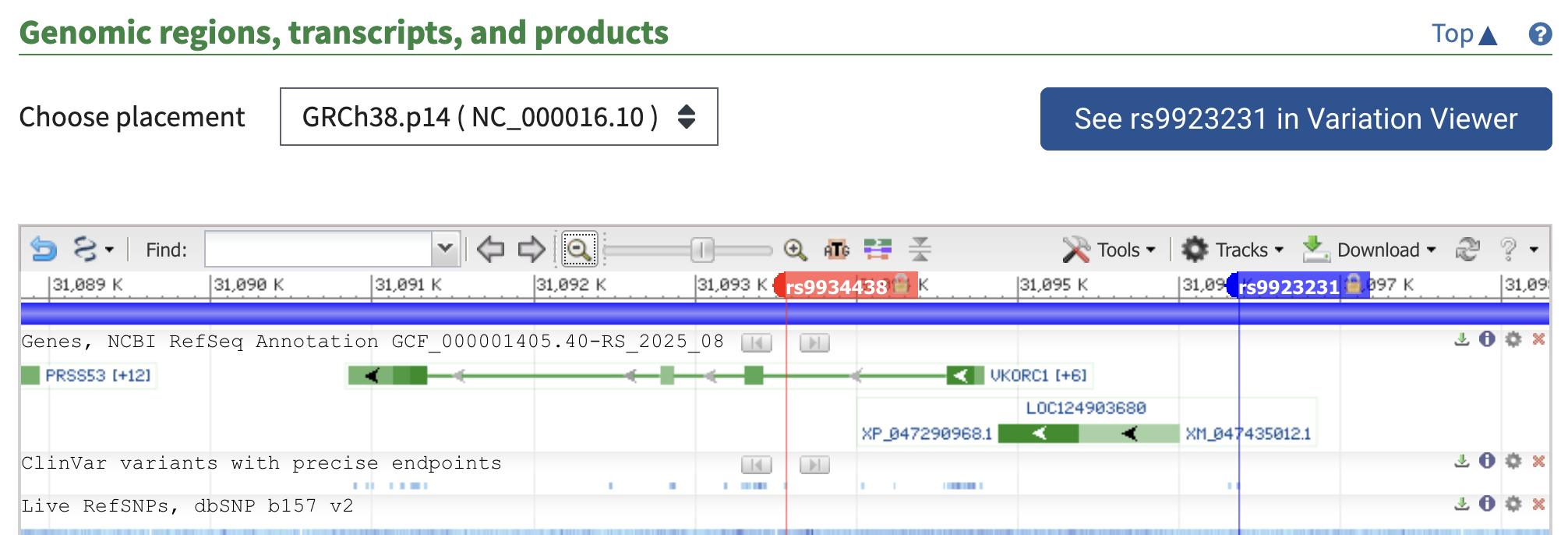
Below is a screenshot from NCBI dbSNP variant details (accessed Oct 6, 2026) showing the two variants which are in high, but not 100%, LD, followed by a short description of each variant.
"Although the sensitivity of rs9934438 as a surrogate marker was 98.6% and specificity reached 100%, the false-negative cases observed in our study highlight a critical limitation. These false-negative results involved patients carrying the AA genotype of rs9923231, for which pharmacogenetic guidelines recommend dose reduction. If only rs9934438 had been genotyped, these individuals would not have been identified as carriers of the clinically actionable rs9923231 AA genotype and therefore might not have received the guideline-recommended dose reduction. Although the clinical consequences were not assessed in this study, such discordant classifications could theoretically be associated with an increased risk of bleeding."
"Based on these findings, we recommend prioritizing genotyping of rs9923231 whenever possible, as this variant directly affects VKORC1 mRNA expression and therefore more accurately reflects its impact on circulat9ing warfarin dose requirements."
The AMP guideline [PMID: 32380173] does not recommend testing rs9934438 as a Tier 1 or 2 allele because, though "it is in high LD with c.-1639G>A in most populations", the linked functional variant (i.e. c.-1639G>A) is already in Tier 1.
The CPIC warfarin guideline discusses the implications of -1639G>A SNV, mapping it to rs9923231, while the DPWG guideline posted online uses only the -1639G>A name (ClinPGx maps DPWG guidance to rs9923231). The French RNPGx guideline also refers to -1639G>A, though it mistakenly maps the SNV to rs9934438 [PMID: 28237404].
We encourage double checking exactly what variant is being tested and reported.